How to Test Soundproofing at Home: A Practical Guide
Learn how to test the soundproofing of your walls, doors, and windows at home — from simple listening tests to app-based measurements.
From the team behind the QuietScore iOS app
You suspect your walls, doors, or windows aren’t blocking enough sound. Maybe you can hear your neighbor’s conversation, or the HVAC hum keeps you up at night. Before spending money on fixes, you need to know where the problem is and how bad it actually is.
This guide walks you through every way to test soundproofing at home — from free methods you can do right now to app-based measurements that give you a real score.
Why test before you fix?
Most people skip testing and go straight to buying soundproofing materials. This is a mistake because:
- You might fix the wrong thing. Your wall could be decent while the door underneath it has a 5mm air gap that lets all the sound through. A $15 door sweep would fix it — not a $2,000 wall upgrade.
- You can’t measure improvement without a baseline. If you add mass loaded vinyl to a wall, how do you know it actually worked? Without a before measurement, you’re guessing.
- Different problems need different solutions. Low-frequency bass rumble requires completely different treatment than mid-frequency speech leakage.
Method 1: The Listening Test (free, 2 minutes)
The simplest test requires nothing but your ears and a friend.
How to do it:
- Have someone stand on the other side of the wall or door
- Ask them to speak at normal conversation volume
- Listen from your side — can you hear words clearly? Just murmur? Nothing?
What the results tell you:
| What you hear | Approximate STC | Verdict |
|---|---|---|
| Every word clearly | Below 25 | Very poor — like having no wall |
| Loud speech heard, words understandable | 25–30 | Poor — standard hollow door |
| Speech heard but can’t make out words | 30–35 | Fair — basic interior wall |
| Loud speech is a faint murmur | 35–40 | Good — solid wall or door |
| Can’t hear anything | 40+ | Excellent |
Limitations: This is subjective and imprecise. It won’t tell you which frequencies are leaking, and it can’t measure improvement after a fix. But it’s a useful first pass to identify your weakest barriers.
Method 2: The Speaker Test (free, 5 minutes)
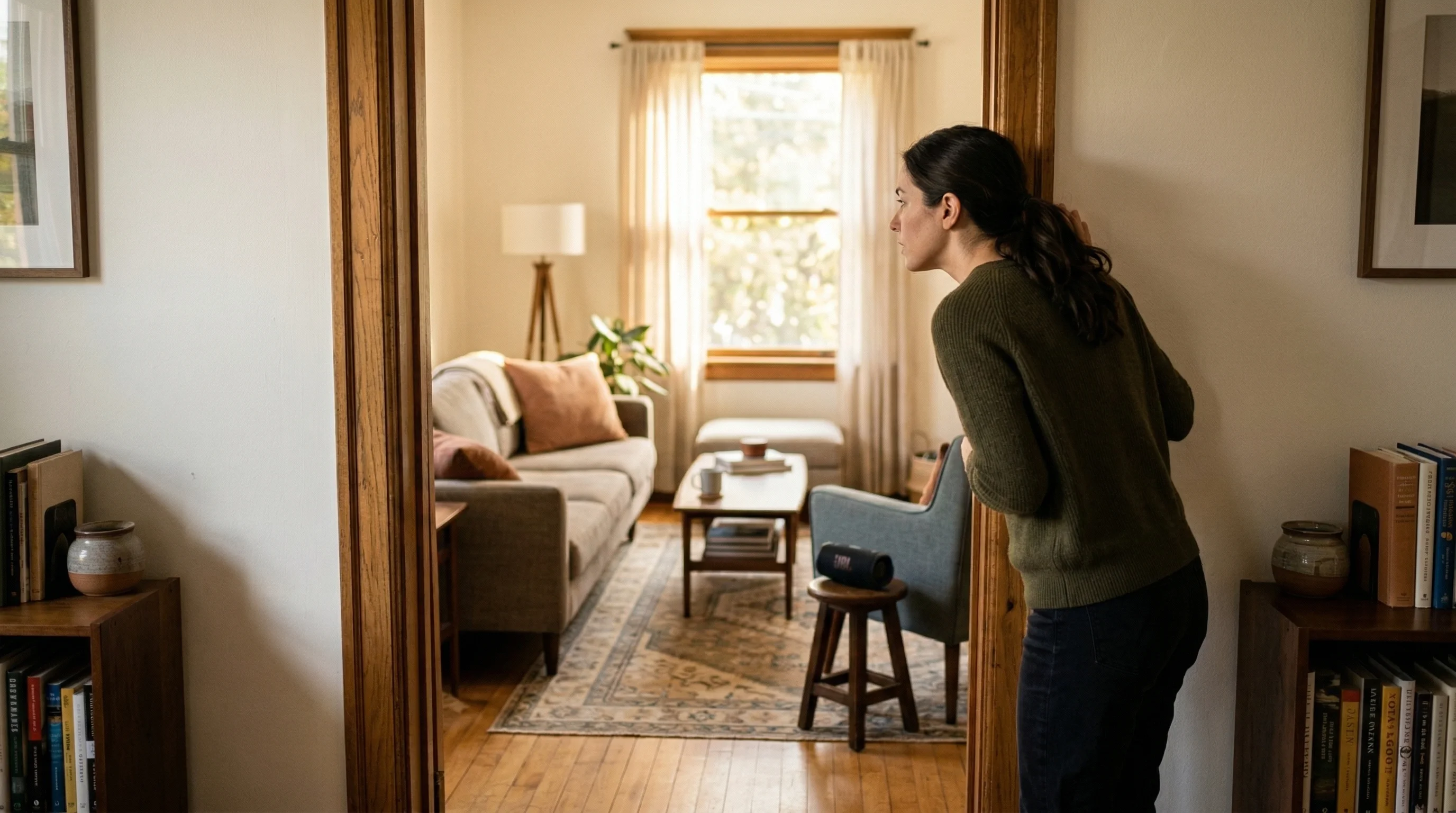
A more controlled version using a Bluetooth or AirPlay speaker or phone.
What you need:
- A Bluetooth or AirPlay speaker or second phone
- A music track or podcast at consistent volume
How to do it:
- Place the speaker against the wall/door on the far side, playing music at a moderate, fixed volume
- Walk to your listening position on the near side
- Note what you hear — bass only? Full music? Nothing?
- Repeat with different barriers (test the door, then the wall next to it)
What to listen for:
- If you hear mostly bass: Your barrier blocks mid and high frequencies well but fails at low frequencies. This is common — low-frequency sound is hardest to block.
- If you hear full-range music clearly: The barrier has poor overall isolation, or there’s a significant air gap.
- If the door is much worse than the wall: Focus your soundproofing effort on the door first.
Pro tip: Try this test with the door open, then closed. The difference tells you how much the door actually contributes. If closing the door barely changes what you hear, the wall itself is the weak link.
Method 3: App-Based Measurement (most accurate DIY method)
For a real measurement with actual numbers, you need an app that can measure the sound level difference across a barrier. This is what QuietScore does.
How it works:
- A Bluetooth or AirPlay speaker plays calibrated test tones on the source side (the noisy room)
- Your iPhone’s microphone measures the sound level on the listening side
- The app compares the two levels across different frequencies
- You get a Sound Isolation Score — a number that tells you how well the barrier blocks sound
What you need:
- iPhone (iOS 26 or later)
- Bluetooth or AirPlay speaker (any decent one — JBL Flip series works well)
- QuietScore app (free tier available)
Advantages over listening tests:
- You get an actual number you can compare before/after improvements
- You see which frequencies leak through (is it bass? speech range? everything?)
- Results are consistent and repeatable
- You can test different barriers and compare them objectively
Limitations:
- An iPhone’s built-in microphone isn’t as accurate as a calibrated measurement mic, especially below 200 Hz. For more accuracy, you can connect a USB measurement microphone (like the MiniDSP UMIK-1) — see our guide to using your iPhone as a sound testing device.
- DIY app measurements give you a Sound Isolation Score that’s comparable to professional STC ratings, but not identical. Professional tests use 16 frequency bands and controlled lab conditions. App-based tests are practical approximations.
Method 4: Professional STC Testing
For situations where you need certified numbers — building code compliance, legal disputes, or commercial construction — you need a professional test.
What’s involved:
- An acoustic consultant visits your site
- They use calibrated equipment: reference-grade speakers, measurement microphones on tripods, sound level meters
- The test follows ASTM E336 (field STC measurement) standards
- They measure transmission loss across 16 frequency bands from 125 Hz to 4000 Hz
- The result is an official STC (or OITC) rating with a detailed report
Cost: $500–$2,000+ depending on the number of barriers tested and your location.
When you need it:
- Building code compliance (new construction or renovations)
- Lease agreements that specify minimum STC values
- Legal disputes about noise between units
- Commercial projects where the architect specifies acoustic requirements
When you don’t need it:
- You just want to know if your door is the problem
- You’re comparing before/after a DIY soundproofing project
- You want to check your apartment’s isolation before signing a lease
For most homeowners and renters, app-based testing gives you the practical information you need at a fraction of the cost.
How to Identify Your Weak Points
Most rooms have one barrier that’s dramatically weaker than the others. Finding it saves you money and effort.
Test every barrier separately
Don’t just test “the room.” Test each element individually:
- The wall — Test with the door closed and any other openings sealed
- The door — Often the weakest link. Test it by measuring with the door open vs closed
- Windows — Single-pane glass is typically STC 26–28; double-pane is 28–34
- Ceiling/floor — If you hear footsteps or voices from above, the floor assembly is failing
- HVAC ducts — Sound travels through ductwork between rooms. Hold your hand near vents — if you feel airflow, sound is getting through
The hierarchy of weakness
In most buildings, barriers rank from worst to best:
- Hollow-core doors (STC 20–25) — The #1 weak point in most homes
- Air gaps under doors, around outlets, at wall/floor junctions
- Single-pane windows (STC 26–28)
- HVAC ductwork — acts as a sound highway between rooms
- Standard interior walls (STC 33–35)
- Exterior walls — usually the best, with insulation and multiple layers
Where sound sneaks through
Sound follows the path of least resistance. Common leakage points:
- Gap under the door — Even 3mm lets significant sound through
- Electrical outlets — Back-to-back outlets on a shared wall create a direct sound path
- Recessed lighting — Holes in the ceiling for can lights bypass the floor’s soundproofing
- Pipe and duct penetrations — Any hole through a wall is a sound leak
- Baseboard gaps — The joint between wall and floor often has a gap hidden behind baseboards
What to Do With Your Results
Once you’ve tested, you know:
- Which barrier is weakest
- How much sound it blocks (approximately)
- Which frequencies leak through
Now you can make smart decisions:
| Your result | Recommended action |
|---|---|
| Score below 20 | Major problem — likely hollow door or huge air gap. Fix the basics first. |
| Score 20–29 | Room for improvement. Seal gaps, consider door upgrade. |
| Score 30–39 | Decent. Targeted improvements (add mass, seal remaining gaps) will help. |
| Score 40+ | Good isolation. Improvement gets expensive from here — diminishing returns. |
For specific improvement strategies, see our How to Improve Your Soundproofing guide.
Next Steps
- Soundproofing 101 — Understand the fundamentals
- Using Your iPhone as a Sound Testing Device — Deep dive into app-based measurement
- How to Improve Your Soundproofing — Solutions for every budget
- Sound Frequency Guide — Understand which frequencies are causing your problem