Soundproofing 101: What Every Homeowner Should Know
A beginner's guide to understanding soundproofing — what it is, how it works, and what STC ratings actually mean in plain language.
From the team behind the QuietScore iOS app
Soundproofing is about stopping sound from traveling between spaces. That’s it. No magic, no mystery — just physics.
If you can hear your neighbor’s TV, your kid’s music, or the HVAC rumbling through the ceiling, your walls, doors, or floors aren’t doing their job well enough. The good news: you can measure it, understand it, and fix it.
What is soundproofing, really?
Soundproofing means reducing how much sound passes through a barrier — a wall, door, floor, or ceiling. It’s different from sound absorption, which reduces echo inside a room (those foam panels you see in studios don’t stop sound from getting through walls).
Soundproofing = blocking sound between rooms. Sound absorption = reducing echo inside a room.
This is the most common mistake people make. Putting acoustic foam on your wall won’t stop your neighbor’s bass. It just makes your room sound better inside.
How sound travels through walls
Sound travels through barriers in three ways:
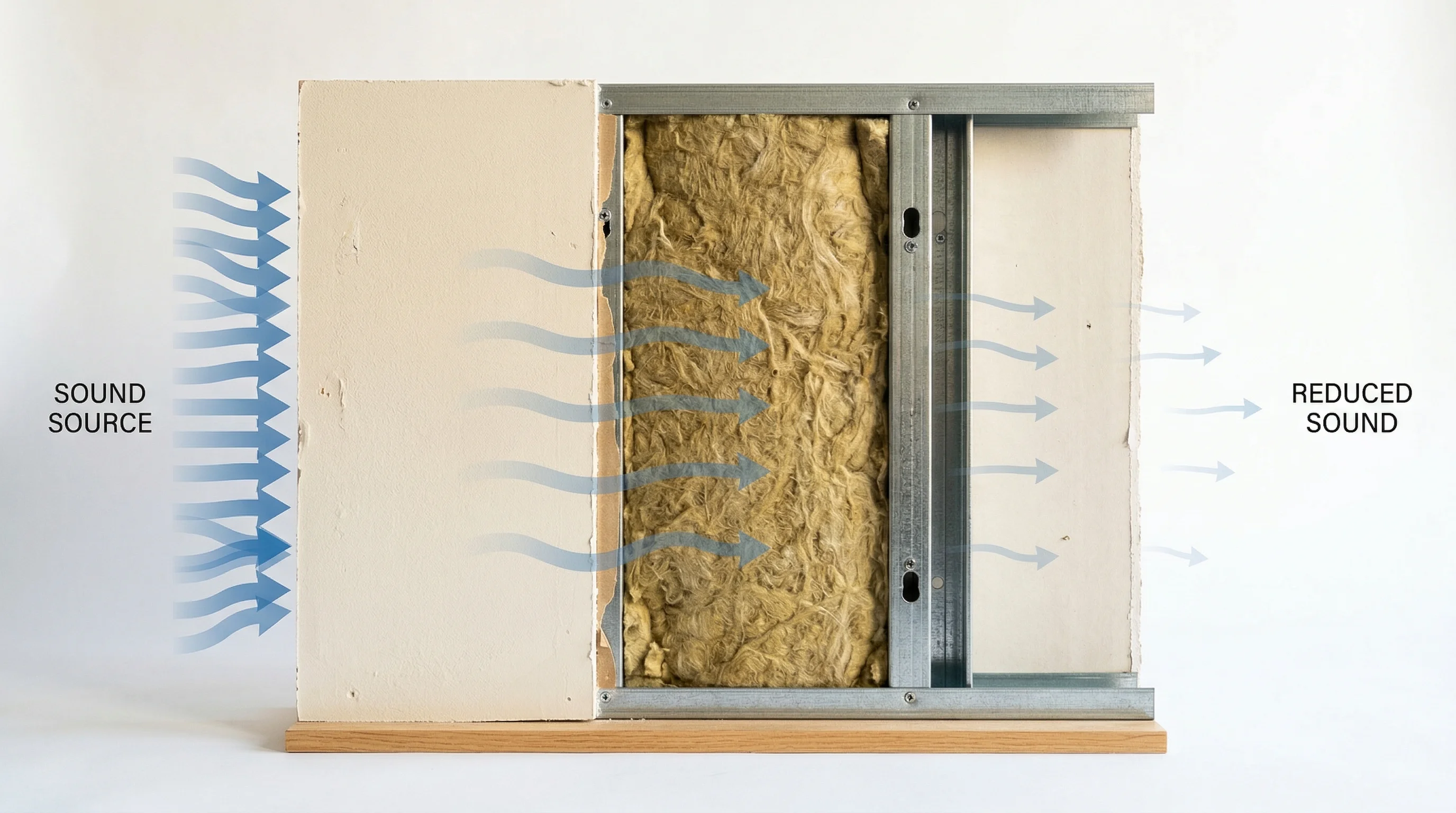
- Through the material itself — Sound vibrates the wall like a drum. Heavier, denser walls vibrate less and block more sound.
- Through air gaps — Any gap, crack, or hole is a highway for sound. A 1% gap in a wall can reduce its soundproofing by up to 50%.
- Through structural connections — Sound vibrates through the building frame from one room to another. This is why you can hear footsteps from upstairs even through a solid floor.
What is an STC rating?
STC stands for Sound Transmission Class. It’s a single number that tells you how well a wall, door, or floor blocks sound. Higher is better.
| STC Rating | What you’ll hear |
|---|---|
| 25 | Normal speech clearly heard |
| 30 | Loud speech heard, normal speech faintly |
| 35 | Loud speech heard but not understood |
| 40 | Loud speech is a murmur |
| 45 | Loud speech not heard |
| 50 | Very loud sounds barely heard |
| 60+ | Excellent — most sounds blocked |
Typical values:
- Standard interior wall (single drywall): STC 33–35
- Solid-core door: STC 30–35
- Hollow-core door: STC 20–25
- Double drywall with insulation: STC 40–45
- Professional studio wall: STC 55–65
The four principles of soundproofing
Every soundproofing improvement uses one or more of these principles:
1. Mass
Heavier barriers block more sound. Adding a second layer of drywall, using mass loaded vinyl (MLV), or replacing a hollow-core door with a solid one all add mass.
2. Decoupling
When surfaces are physically separated, sound can’t vibrate directly through. Resilient channels, isolation clips, and floating floors break the vibration path.
3. Absorption
Filling cavities with dense insulation (mineral wool, fiberglass) absorbs sound energy as it passes through. This works inside walls, not on the surface.
4. Damping
Damping compounds (like Green Glue) convert sound vibration into tiny amounts of heat. Applied between two rigid layers, they significantly reduce sound transmission.
Where to start
Before spending money on soundproofing improvements, test what you have. You might have a wall that performs fine except for a gap under the door — a $10 door sweep could solve your problem instead of a $1,000 wall upgrade.
The key steps:
- Identify the weak point — Is it the wall, door, window, or ceiling?
- Measure the current performance — Use an app like QuietScore to get a baseline score
- Fix the easiest problems first — Seal gaps, add weatherstripping, replace hollow-core doors
- Upgrade if needed — Add mass, decouple, insulate
Next steps
- How to Test Soundproofing at Home — Step-by-step testing guide
- How to Improve Your Soundproofing — Solutions for every budget
- Sound Frequency Guide — Which frequencies are causing your problem